


Experience Creates Change
I’ve been thinking a lot lately about what actually creates change in therapy.
At The Therapeutic Workshop, we do therapy in a lot of different ways. Sometimes it looks pretty traditional. Two people sitting in a room talking. Other times we might be walking through a park, making art, playing a tabletop role-playing game, practicing something together, or doing trauma work.
Those things can look really different from one another.
But I’ve recently found some language for something that I think has been underneath a lot of the work we’ve been doing for a long time:
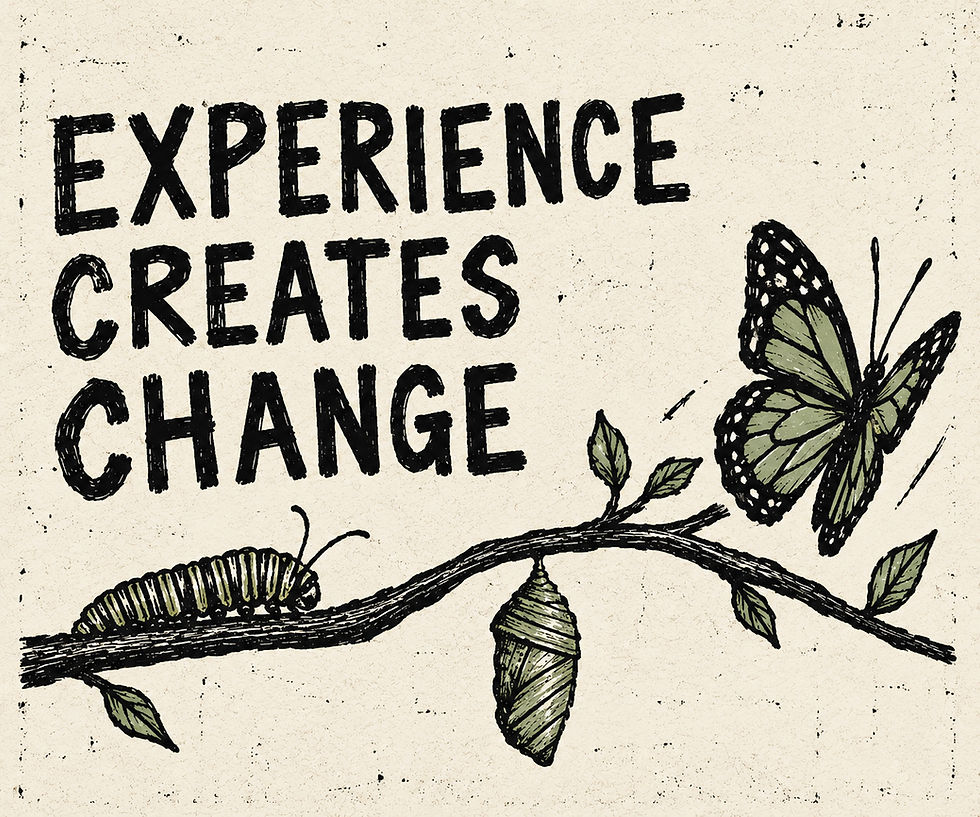
Experience creates change.
And if we want healthy change, we need to create safe experiences.
We learn through experience
All of us are constantly learning from what happens to us.
If every time I speak up I get shut down, I learn something about speaking up.
If conflict in my relationships has usually meant yelling, someone leaving, or something bad happening, my nervous system learns something about conflict.
If I’ve taken a risk and been embarrassed or rejected, I might become pretty good at avoiding taking that risk again.
A lot of these lessons make sense. They helped us adapt to the experiences we were having.
The problem is that sometimes those lessons stick around even when they aren’t particularly helpful anymore.
I can understand intellectually that my current relationship is different and still feel my body preparing for something terrible when we disagree.
I can know that the people around me probably aren’t judging me and still feel incredibly anxious walking into a room full of people I don’t know.
I can understand where a response came from and still have that response.
That’s one of the places where I think therapy can be really helpful.
We can understand the old experience.
But we can also start creating new ones.
Actually experiencing something different
Sometimes we spend a lot of time talking about what we would like to do differently.
And talking is important. Understanding ourselves is important.
But there’s also a big difference between talking about something and actually experiencing it.
It’s one thing to talk about setting boundaries. It’s another thing to set one and have somebody respect it.
It’s one thing to understand that disagreement doesn’t have to destroy a relationship. It’s another thing to disagree with someone, work through it, and find out that they’re still there afterward.
It’s one thing to learn about anxiety and our nervous systems. It’s another thing to notice yourself becoming anxious, stay with the experience, use something you’ve practiced, and feel your nervous system settle again.
It’s one thing to talk about being afraid of screwing something up. It’s another thing to screw it up and discover that you’re okay.
Those experiences matter.
And I think therapy can be a really good place to create them.
Safe doesn’t necessarily mean comfortable
I think this distinction is important.
When I say that we want to create safe experiences, I don’t mean that therapy should always feel comfortable.
Sometimes healthy experiences are uncomfortable.
We might feel anxious. We might get frustrated. We might disagree. We might try something and fail. We might talk about something painful. We might feel vulnerable or unsure of ourselves.
The goal isn’t to remove all of that.
The goal is to create enough safety, support, choice, and connection that we can have a difficult experience without simply repeating the experience of being overwhelmed by it.
If I’m working on anxiety, the goal probably isn’t for me to never feel anxious again.
Maybe I need more experiences of feeling anxious and discovering that I can handle it.
If conflict has always felt dangerous, I probably don’t need a life where nobody ever disagrees with me.
I may need experiences of conflict that are safe. Where someone listens. Where I can listen. Where we can repair something. Where the relationship is still there when we’re done.
Over time, those experiences give us something new to learn from.
Why we do therapy in so many different ways
This has also helped me put better language around why we do so many different kinds of therapy at TTW.
It isn’t because we think therapy needs to be unusual or creative for the sake of being creative.
It’s because different ways of doing therapy can create different experiences.
Walking alongside someone through a park can feel very different from sitting across from them in an office.
Making something in art therapy gives us an opportunity to create, experiment, get frustrated, make mistakes, express something without words, and see what happens.
In TTRPG therapy, we can talk about communication, anxiety, frustration, boundaries, asking for help, or trusting other people. But we can also create situations in the game where someone actually has to try those things. We get to practice them and see what happens.
Groups give us opportunities that individual therapy can’t. If I’m trying to get better at relationships with other people, eventually I probably need some other people around.
Even the way we approach trauma fits into this.
In Brief Solution Oriented Trauma Resolution (BSOTR), we’re working with experiences that have continued to affect someone long after they happened. We’re not only talking about the experience. In a safe and intentional way, we’re re-experiencing aspects of it from a very different place, with resources, agency, support, and possibilities that weren’t there when the original experience happened.
We aren’t changing the fact that something happened.
But we may be able to change the experience we carry forward from it.
And not every good experience needs to happen in therapy
This idea goes beyond therapy for me, too.
Over the last few years, we’ve put more and more energy into creating free community events at TTW.
Those aren’t therapy.
That’s important to us, and we’re pretty intentional about saying it.
Sometimes we’re just creating an opportunity for people to get together and make something. Or play a game. Or spend some time outside. Or meet some people who are into the same weird stuff they’re into.
Because those experiences matter too.
Showing up somewhere when you’re nervous and finding out you’re welcome matters.
Making something just because making stuff feels good matters.
Playing matters.
Laughing with people matters.
Feeling like you belong somewhere matters.
We don’t need to turn every good thing for our mental health into therapy.
Sometimes we just need more opportunities to have good experiences.
Experience creates change
I don’t think any of this means we stop talking.
Talking helps us understand what happened to us. It helps us recognize patterns, make meaning, learn new things, and decide what we want to do differently.
But I think we can go one step further.
What would it be like to actually experience something different?
If experience taught me that people aren’t safe, maybe I need experiences with people who are.
If experience taught me that I shouldn’t speak up, maybe I need experiences where I do.
If experience taught me that I can’t handle feeling anxious, maybe I need experiences where I’m anxious and find out that I can.
If experience taught me something about who I am or what the world is like, understanding where that lesson came from can be incredibly valuable.
But maybe I also need some new experiences to learn from.
Experience creates change.
So let’s be thoughtful about the experiences we’re creating.


Comments